Fetal weight estimates drive how babies are born. Today's estimates are least reliable at the extremes, where they matter most. Growth Intelligence is accurate across the spectrum.
More than half of growth-restricted fetuses go undetected. Macrosomic cases are missed more often than they are caught.
Estimated fetal weight is frequently the most important factor guiding clinical decisions during pregnancy—including heightened surveillance, induction of labor, and cesarean delivery (Kadji et al., Am J Obstet Gynecol 2022). Below the 10th percentile for gestational age, a fetus is classified small for gestational age and enters a surveillance pathway—Doppler studies, serial ultrasound, early delivery planning (American College of Obstetricians and Gynecologists [ACOG] Practice Bulletin 227, 2021). Above 4,500 grams, it triggers counseling for cesarean delivery to avoid shoulder dystocia (ACOG Practice Bulletin 216, 2020).*
*For diabetic pregnancies, this threshold is 4,000 grams.
The formula used in the vast majority of clinical settings was derived from 167 patients at a single hospital in 1984 (Hadlock et al., 1984). No general-purpose formula developed since has outperformed it on aggregate metrics (Hammami et al., Ultrasound Obstet Gynecol, 2018)—but aggregate performance conceals the problem at the clinical margins, where decisions carry the highest stakes.
The result is a detection gap that is widest exactly where it matters. ACOG reports that sensitivity for detecting birth weight above 4,500 grams ranges from 10 to 45 percent (ACOG Practice Bulletin 216, 2020). Approximately half of all fetal growth restriction cases go undetected, even in high-income countries (McCowan et al., 2018).
One analytic study found that systematic error in the current formula means roughly one in four fetuses estimated at the 20th percentile is actually below the 10th—the threshold for enhanced monitoring (Lappen & Myers, Am J Obstet Gynecol, 2017).
"For suspected macrosomia, the accuracy of estimated fetal weight
using ultrasound biometry is no better than that obtained with abdominal palpation."
-ACOG Practice Bulletin 216, 2020
GI's algorithm is derived from a biological model of growth, not a statistical fit to a single clinical dataset. The same biological model holds across species, from nematodes to humans; only its parameters are species-specific.
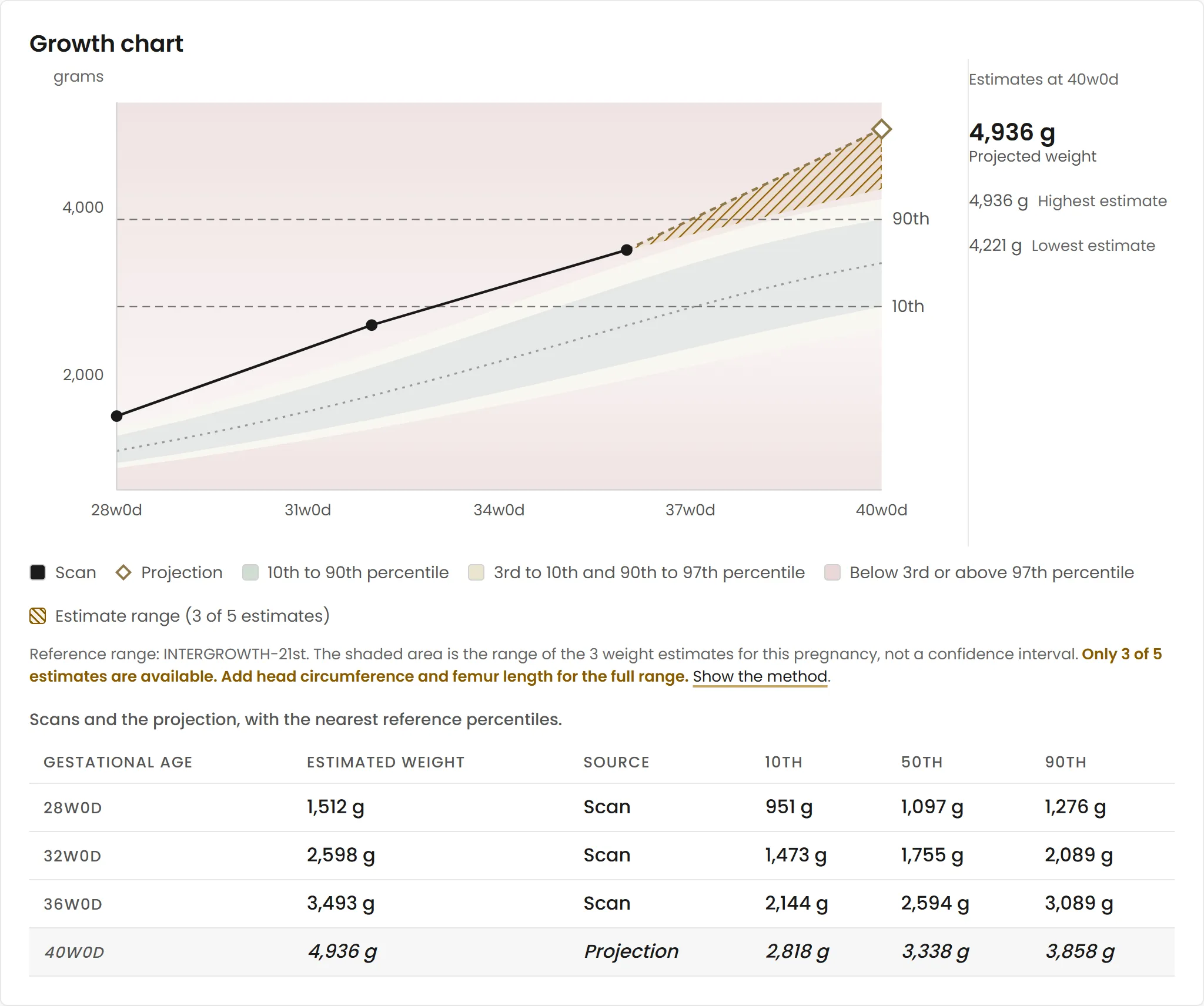
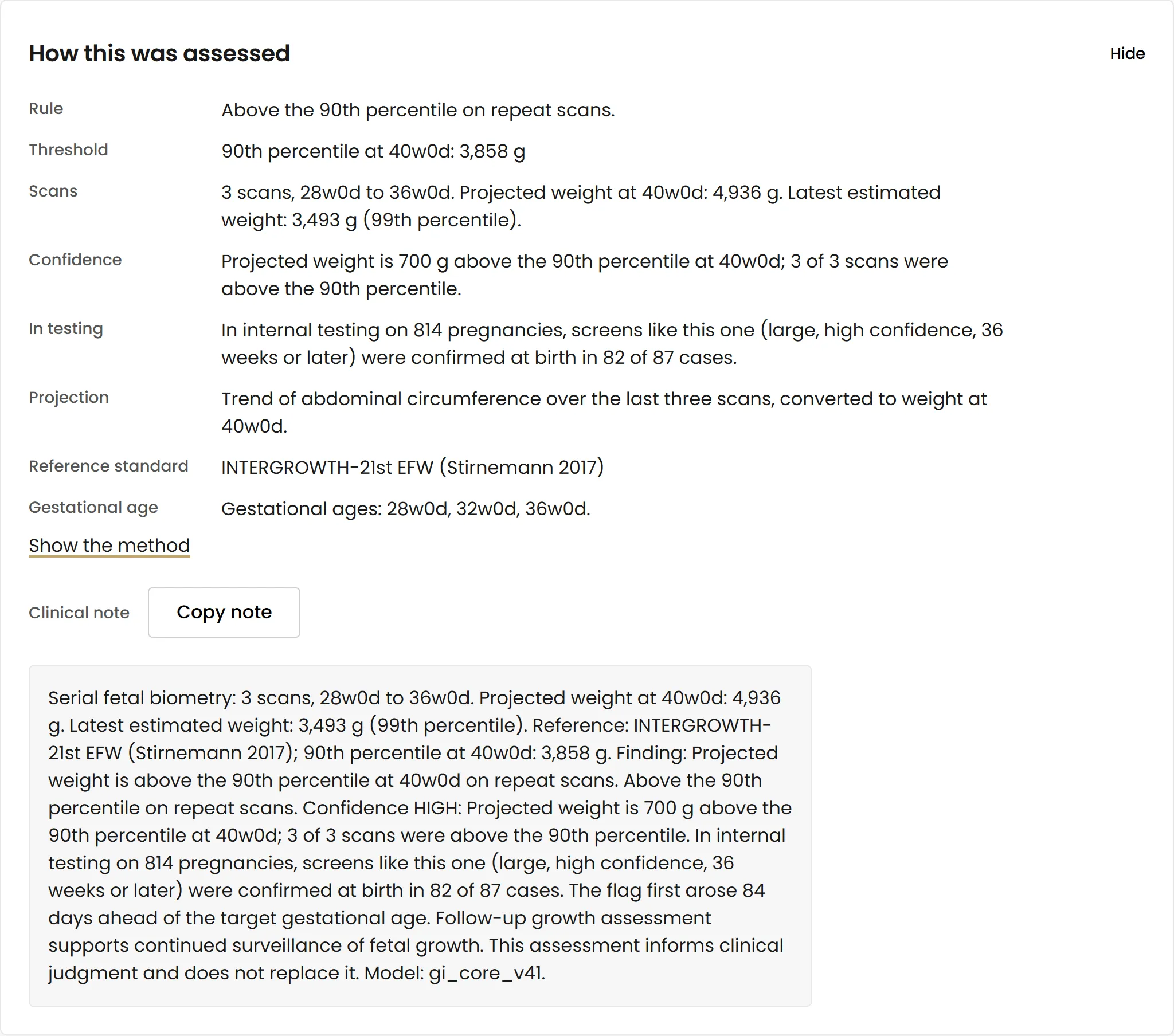
Growth Intelligence detects growth restriction and macrosomia with higher sensitivity than current screening methods.
One measurement per scan. Seconds to results. Ten patents pending.
Published comparators at various thresholds: ultrasound sensitivity for birth weight above the 95th percentile is 59% (Kadji et al., Am J Obstet Gynecol 2022). ACOG reports 10–45% sensitivity for birth weight above 4,500g (Practice Bulletin 216, 2020). Third-trimester screening detects 20–67% of growth-restricted babies depending on protocol.
In cross-validation on a clinical dataset of over 700 pregnancies
with known birth weight outcomes:
SGA detection: 86% sensitivity at 69% specificity.
LGA detection: 81% sensitivity at 78% specificity.
GI's estimation bias is near zero across the weight spectrum. In near-birth validation, the most widely used formula overestimated fetuses under 2,500 grams by +9.8%—systematically classifying growth-restricted babies as normally grown. GI's error for the same population was +0.6%.
A clinician enters a standard measurement already collected in a routine scan. GI returns a growth assessment in seconds—web-based, no hardware, no installation.
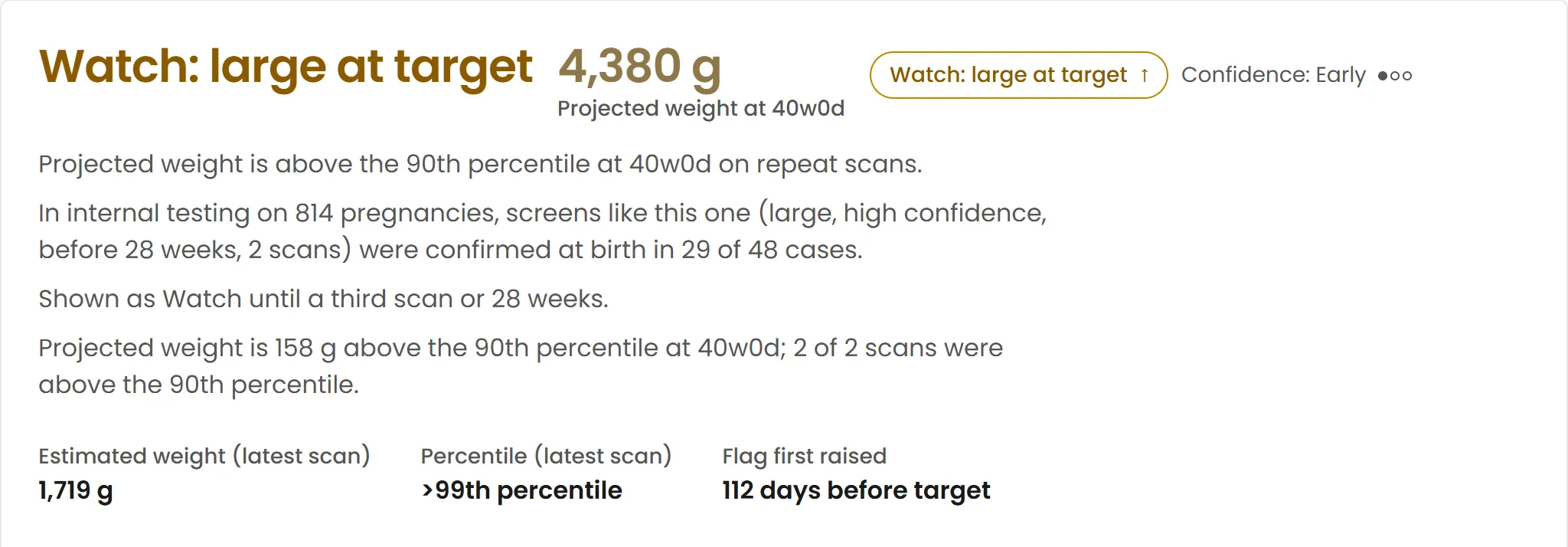
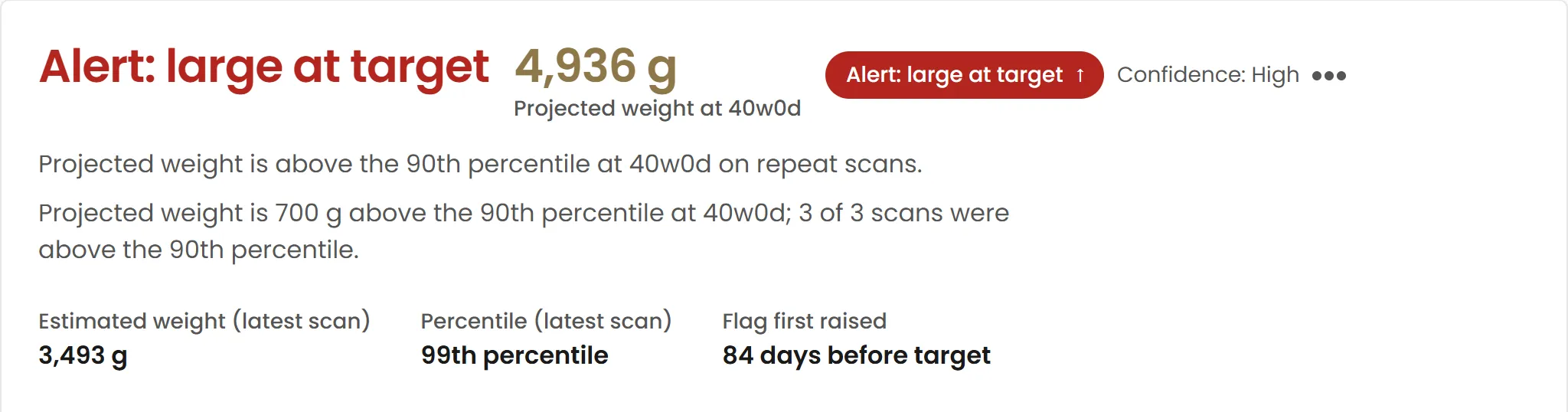
Each measurement adds to the growth trajectory, improving detection confidence over time.
The examination doesn't change. What changes is what happens to the measurement after it's taken.
We offer complimentary retrospective analysis to any hospital or provider. Submit historical biometry and birth weight data, and we return a detailed performance analysis on your patient population.
Detection performance was evaluated through 200-iteration Monte Carlo cross-validation on 775 pregnancies with known birth weight outcomes, testing robustness across random patient splits. Near-birth accuracy was assessed on measurements taken within 7 days of delivery, with each estimate carried forward to the delivery date at an established third-trimester growth rate of 26 g/day (Michaelson et al.).
Performance metrics (Wilson Score 95% CI, full dataset):
Monte Carlo 95% CI (200 iterations, 70/30 splits):
SGA Monitoring Sensitivity: 85.2% [77.8%, 93.3%]
SGA Alert Sensitivity: 75.5% [65.2%, 84.8%]
LGA Sensitivity: 81.2% [72.1%, 88.6%]
Prevalence: SGA 19.5%, LGA 28.3%. INTERGROWTH-21st neonatal standards for percentile classification.
Lead time: median interval between first true-positive flag and delivery. LGA: 11.7 weeks (n=185). SGA monitoring: 7.7 weeks (n=134). SGA (birth weight below the 10th percentile, INTERGROWTH-21st neonatal standards) proxies fetal growth restriction.
In 2024, the American Law Institute revised the legal standard for medical negligence, moving it from strict reliance on prevailing custom toward evidence-based evaluation of reasonable care. As tools with better detection performance become available, what counts as reasonable care will continue to evolve.
In May 2024, the American Law Institute approved its first-ever Restatement (Third) of Torts: Medical Malpractice, shifting the standard of care from strict reliance on prevailing custom toward evidence-based evaluation of reasonable care (summarized in Aaron et al., JAMA, 2025). Compliance with prevailing custom remains relevant, but is no longer necessarily decisive.
Courts have held that an entire profession's failure to adopt available technology does not insulate individual practitioners from liability. The principle was first applied to medicine in Helling v. Carey (Wash. 1974): physicians were held liable for failing to administer a simple, available diagnostic test—though professional custom did not require it—because the test was inexpensive, harmless, and could have prevented serious injury. In 2024, the ALI's Restatement adopted a framework consistent with this reasoning at the national level.
Fetal weight misestimation has produced verdicts reaching tens of millions of dollars. In Manning v. Pecos Valley of New Mexico (2018), a $73 million verdict involved underestimation of fetal weight where the defense's own experts described the care as "indefensible." In Swanson v. Northern Westchester Hospital Center (N.Y. 2009), a brachial plexus injury from shoulder dystocia produced an award of $56 million at trial.
In 2025, a federal district court held that the standard of care requires clinicians to account for a 20 percent margin of error in estimated fetal weight—while holding that professional guidelines do not set the ceiling for reasonable care (Raposo v. United States, D. Alaska 2025). Applying that margin to a 4,200-gram estimate yielded approximately 5,040 grams, crossing the threshold at which cesarean delivery should be considered; the court evaluated each provider's conduct against the estimate available at the time.
Other published verdicts include Zhao v. United States (S.D. Ill. 2019, $8.3M), Rodriguez v. Yale-New Haven Health (Conn. 2023, $6.5M), and Klutschkowski v. PeaceHealth (Ore. 2011, $1.9M).